Author Archive

Making Music With Guns

By From http://www.musingsoverapint.com/ • May 11th, 2017 • Category: Blog Entries.Local

This guy has fun combining his love of firearms and music.I really need to work on my strong hand and weak hand only shooting.
[ This content originated at Musings Over a Pint ]


Traffic 1, Shooting 0

By From http://www.musingsoverapint.com/ • May 10th, 2017 • Category: Blog Entries.Local

I had blocked off some calendar time on Tuesday for my (almost) weekly trip to the indoor range. A planned conference call ran long, but it seemed I still had time to make the trip. That is until I got to the overpass at the interstate.Why is the exit …


Drills For The Indoor Range

By From http://www.musingsoverapint.com/ • May 9th, 2017 • Category: Blog Entries.Local

Whenever I run across interesting shooting drills online I save them in my notes, and I’ve put together a pretty diverse catalog. Because of limitations typically found at indoor ranges, I’ve long kept an eye out for drills suitable for indoor practice.

The main restrictions typically faced indoors are prohibitions on drawing from the holster, lack of movement, use of a single target and sometimes shooting speed. Recently the outdoor range we use has banned movement and also severely limited the rate of fire. Individual strings of fire are now limited to two shots. They’ve even gone to so far as to ban multiple people sharing a bay from shooting simultaneously in what only sounds like rapid fire.

Fortunately, the indoor range has a less restrictive stance on multiple shot strings. There’s no shooting on the move or holster work, despite that it seems the advantage still goes to the indoor range for most practice time.

Below are a few of the drills I’ve found that are useful for a structured practice session indoors.

Julie Golob 50 Shot Drill
http://www.shootingusa.com/PRO_TIPS/JULIE2015-1-50Round/julie2015-1-50round.html

This is one of my favorites. It’s simple and uses either USPA or IDPA targets. All strings start from low ready and the target distance is up to the shooter. Your magazine should be loaded with 10 rounds. If you have five mags pre-loaded the drill runs very quickly. Shoot as fast as you can to keep all your hits in the scoring zone.

Magazine 1: 2 rounds, center of this target, repeat 5 times
Magazine 2: 5 rounds, center of target, followed by 5 rounds to head
Magazine 3: 2 rounds, quickly into head, repeat 5 times
Magazine 4: 1 to body, 1 to head, repeat 5 times
Magazine 5: 5 rounds SHO into body, followed by 5 rounds WHO into body

Count only -0 or A zone hits.

Tactical Professor – Establishing Your Baseline
https://tacticalprofessor.wordpress.com/2015/09/25/friday-fundamentals-01-establishing-your-baseline/

This is another 50 round drill for any silhouette target of your choosing; B-27, B-21, Q, IDPA, IPSC, etc. All shots are from low ready, with reloads on bench. You’ll need two magazines loaded with five rounds for each string. Each string of fire consists of a 10 shot sequence and is repeated at 3, 5, 7, 10, and 15 yards.

Shot sequence:
1) One shot at center, follow thru for 1 sec, back to low ready
2) Two shots at center, follow thru for 1 sec, back to low ready
3) Three shot at center; will be at slide lock after 2 shots, reload fire 1
4) Four shots at center (slide lock)

Score only hits in the body or main scoring zone of your target. Be sure to drop the empty mag into your hand, not into the lane in front of the shooting bench.

5×5 Drill
http://loungecdn.luckygunner.com/lounge/media/5×5-drill.pdf

This is a simple 5 shot drill, though your indoor range has to allow fairly fast shooting. From low ready, put 5 shots in a 5 inch circle in 5 seconds. I’ll typically use a “splatter” target stuck over whatever target I’ve shot up with previous drills. The 5 seconds is going to be an estimate unless you can use a timer.


Dot Torture
https://pistol-training.com/drills/dot-torture

Though not one I’ve specifically flagged in my notes for indoor shooting, this is a great test of your sight alignment and trigger control. The drill as designed calls for drawing from the holster, but shooting from low ready will provide a significant “torture.” Start at 3 yards until you shoot it with a perfect score of 50 hits. I’ve yet to shoot better than 49/50, but I am overdue to try again.

These drills are all part of my regular range routine. Of course, one could also simply hang a target and run it out to your preferred practice distance and just shoot. And I do that sometimes as well. However, I like to include at least one of my favorite standard drills in each range trip.


[ This content originated at Musings Over a Pint ]


Maryland State IDPA Match

By From http://www.musingsoverapint.com/ • May 8th, 2017 • Category: Blog Entries.Local

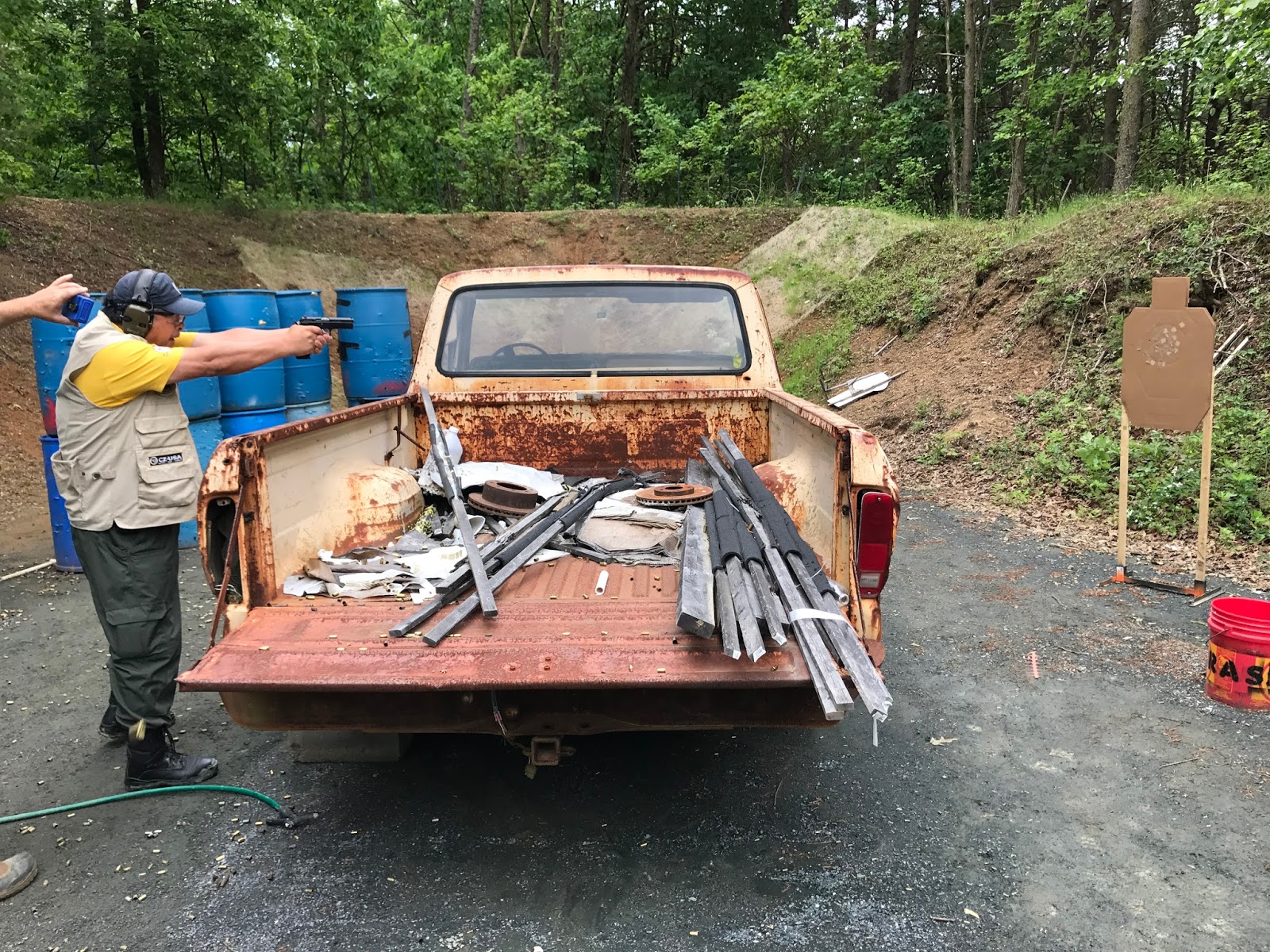
On Saturday I ventured into Maryland to shoot the 2017 Maryland State IDPA Championship. My alarm clock sounded early Saturday morning in preparation for the two hour drive to the match. Gun in locked container – check. Ammo in a separate locked container – check. Both containers out of reach of the passenger compartment – check. Copy of Title 18, Sec. 926A of the United States code – check. There was a sporadic misting rain during the drive but the weather apps on my phone predicted no rain during match time. The weather throughout the day was cloudy with some breeze, and a few times the rain seemed very threatening, but ultimately held off. It was pretty much perfect shooting weather.

Ten very interesting stages of shooting fun were waiting for us. The bays were still wet, and even muddy in some spots from the rainfall the previous day, which is when the match staff shot. Fortunately those conditions really only affected Saturday’s shooters when pasting and resetting targets, not while shooting. 
The opening stage for our squad was called “Riot” and involved shooting from behind an open car door. In a change from the initial stage description preview, there was an added requirement to shoot from a kneeling position, between the door jam and the car. Being of shorter disposition, that required me to keep my back straight to gain the height I needed. Finishing with 0 points down for the stage was a good way to start the match. 
Another interesting stage was called “Relaxing at Home.” We started seated on front of an electronic gun safe in which there was a pistol, loaded with just four rounds. At the start we punched in the safe’s code and retrieved the gun, then engaged two targets on the move. The trigger on the gun was surprisingly “mushy” so my first shot was a long time coming. I typically don’t shoot handguns with manual safeties, so I spent a lot of time before shooting reminding myself to flip the lever. After setting the pickup gun down, we grabbed our own gun and ammo off a table to finish the course. This was another -0 stage for me.
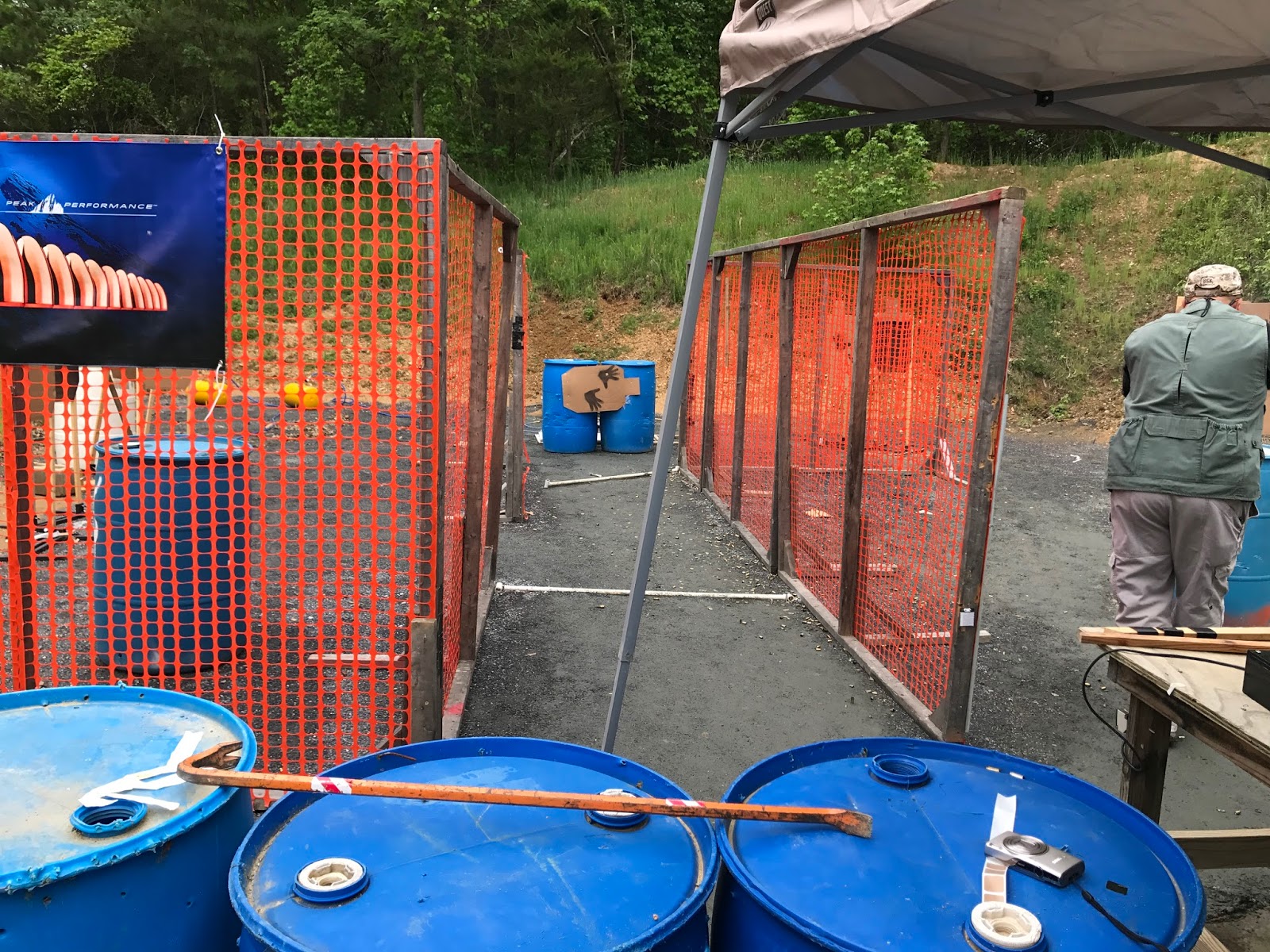
Stage 6 was a fun stage aptly named “Hose Fest.” Three low targets were hidden behind barrels at three separate shooting positions. You had to run right up to the barrels and shoot over them, putting six hits into each target. The stage was done running left to right, so attention to the 180 was critical, especially when reloading. The shooter essentially ran the next position and had to turn to face the targets. The stage was interesting for me as it was the first time I had tried shooting the P320 that quickly. I found I can’t, yet, pull the trigger as fast as I can with the P226 single action.
The standards stage had four paper targets and four steel poppers. The steel and two of the paper were set at 35 yards! Not having shot the new gun at distance greater than 20 yards, this was a new experience. I ended up 10 points down for the stage, which included one miss on paper. Despite that it wasn’t my lowest stage finish. My shots were hitting low, so I’ll spend some time overcoming that, though I don’t have much of an opportunity to shoot beyond 25 yards in practice. 
The two scenario stages on which I had the most shot points down, just 6 points on each, also had penalty points added to my score. In retrospect it seems that mental errors rather than shooting cost me the most. In “Day at the Office” there was a swinging target activated by the shooter using his hand to knock over a steel popper next to his seat. An interesting turning target that gave three exposures was started by shooting another steel target in the stage. My plan was to shoot the swinger last. When I finished the other targets, I aimed to shoot the swinger —and it wasn’t there! I had neglected to activate it at the start. The stage description required the swinger to be activated before shooting any targets, so I had a Procedural Error penalty added to my score. 
The other mental error was on the final stage I shot, “Coming Down the Hallway.” The shooter passed ban electric sensor which activated a VERY fast up and over target. It also started a swinger that appeared only three times, with a slight pause between, and at each of it’s appearances. To hit the quick up and over target you had to be already shooting at it when it appeared. Getting one hit on the target was cause for celebration. I spent so much time concentrating on my plan for shooting that target, I neglected to pay much attention to the swinger’s action. When I got to it, the target was hidden, so I moved to another target in the array. The mover then made it’s final appearance, and disappearance, before I could get back to it. This forced me to attempt a very tight shot at a piece of the technically disappearing target, hitting a non-threat. I should have simply waited on the target as that delay would have been less than the 5 second HNT penalty.
All of the stages provided fun and challenging shooting scenarios. Our match fee also included a delicious lunch from Southern Bobby-Q Catering. The meal provided a nice break mid-match for relaxing and socializing. Although the poor planning mentioned above did occur AFTER taking time to fill my belly; maybe I needed a post-lunch nap!

The match flowed very smoothly and we had minimal waiting time between stages. Shooting started promptly at 9:00 AM and we finished around 2:30 PM. The award presentations took place about an hour later.

This was my first time shooting the new SIG Sauer P320 in a match. I was nervous, but at the same time confident in my ability to shoot it. Overall I was extremely pleased with how well it went. I was happy with most of my times, and I even finished three stages -0 down. Finishing 4th of 20 in SSP Sharpshooter earned me a glass trophy; literally a mason jar drinking glass. How appropriate. My overall finish was 27th of 134. 
Virginian’s traveling into Maryland are subject to random stops on the highway by state enforcers targeting Virginia drivers. After being patted down on the side of the road when returning from the Chesapeake Cup simply for legally transporting firearms, I was more than a little anxious about this trip. I’ve attend a few events put on by the Sanner’s Lake Sportsman’s Club and know it’s always a well-organized and fun match, so I didn’t let the threat of police harassment sway me from attending this event. I had a great time shooting the MD Championship match and that, perhaps, makes future trips to shoot in Maryland a little more likely.
I’ve posted more pictures from the match on Flicker

[ This content originated at Musings Over a Pint ]


Five O’Clock Friday: Heaven vs. Hell

By From http://www.musingsoverapint.com/ • May 5th, 2017 • Category: Blog Entries.Local

May your weekend be heavenly.Source
[ This content originated at Musings Over a Pint ]


LA Sheriff’s Department Pistol Team – 1936

By From http://www.musingsoverapint.com/ • May 4th, 2017 • Category: Blog Entries.Local

Some egregious gun safety violations, but an interesting historical look nonetheless.Kids, don’t try this at home.
[ This content originated at Musings Over a Pint ]


It’s Coming, Prepare Well

By From http://www.musingsoverapint.com/ • May 3rd, 2017 • Category: Blog Entries.Local

This video from the so-called “antifa” movement, i.e. communist thugs, has been making the gun blog rounds. Folks are finding it easy to mock them for the obvious safety violations and poor marksmanship. The derision is well deserved.At the same time, …


May Day Range Trip

By From http://www.musingsoverapint.com/ • May 2nd, 2017 • Category: Blog Entries.Local

I heard the communists were planning a day of rioting on May 1, so I decided to add some balance to the universe with a trip to the indoor shooting range. When I arrived at the facility, the parking lot was more full than I’ve seen it recently. Fortuna…


Beer For Pain Relief

By From http://www.musingsoverapint.com/ • May 1st, 2017 • Category: Blog Entries.Local

More good news you can use. A recent study is claiming that two pints of beer are more effective than Paracetamol (Acetaminophen) for pain relief. Frankly, I’m not sure how much of a revelation it is to find that alcohol reduces pain — I’ve been known to “relax” my sore muscles with a beer or two.

This sentence in the article did jump out at me…

Now the experts are planning to find out if alcohol either lowers anxiety of pain, which then reduces the perception of discomfort, or if it numbs the sensation of pain by affecting the brain receptors

Science. It’s all about the details.

[ This content originated at Musings Over a Pint ]


Notes on Dry Fire

By From http://www.musingsoverapint.com/ • May 1st, 2017 • Category: Blog Entries.Local

I haven’t been as dedicated to dry fire practice recently as I would like. Gone are the days when I was getting in 30-60 minutes daily, rather it’s closer to 10 – 20 minutes once or twice a week. But even at that rate, there is benefit.

One lesson I remind myself of constantly in dry fire is grip pressure. It’s easy to get sloppy with the grip on the firearm when the gun isn’t actually firing. I had to break a weaker grip habit a few years ago after many months of poor habits in dry fire practice. If my hands don’t show signs of the grip texturing after practice, I know I was sloppy with the grip.

Dry fire practice is a bit different with the striker fired SIG P320 than it was with the double/single action P226. Rather than every trigger pull being a full DA pull, the P320 practice is a lighter “dummy” pull. Despite the dead trigger, it’s more realistic.

Practicing reloads is a changed experience as well. The P226 slide would go forward from slide lock when the magazine was slammed into place. In addition to that being less reliable than slingshotting the slide, I got “trained” to not do it. That caused issues when the slide didn’t go forward on its own. I never spent significant time just practicing slide lock reloads until switching to the new gun.

To work on the reloads, I fill a magazine or two with inert dummy rounds and place them on the belt. The gun has an empty magazine and the slide locked back. Starting with the gun positioned like I just fired the last round, I drop the magazine, retrieve the “loaded” magazine from the belt and complete the reload — remembering to rack the slide. Then the loaded mag goes back on the belt, an empty mag is inserted into the gun. Racking out the dummy round locks the slide back, and the process is repeated. Again, and again.

Under the 2017 IDPA rules, reloads with retention, as well as reloads on the move come into play more frequently. I combine reloads with retention, or tactical reloads, with movement drills. My concentration when moving is on my feet and only pulling the trigger at the most stable part of the step. In my basement dry fire area, the floor is covered with various rugs. This provides enough surface variation to balance keeping the feet on the ground as much as possible, while lifting them enough to prevent tripping.

During each practice session, it’s important to always use a timer for the start beep when practicing drawing the gun. I also work on table starts, with both a “loaded” and unloaded gun. There are multiple targets, and even a barricade set up in the basement, so just about every draw of the gun is combined with “shooting” multiple targets and some movement.

Twenty minutes is about the maximum time for effective dry fire practice, for me at least. That time encompasses dozens of gun draw and magazine changes. Interestingly, looking through my notes, hardly a session goes by that I don’t recognize some improved technique or point for awareness. Now I only need to get to it more frequently.

[ This content originated at Musings Over a Pint ]