Fratello and Maker’s Mark Bottle Kill
Author: David From http://www.musingsoverabarrel.com/ • Apr 10th, 2022Category: Blog Entries.Local
According to a report published by the Virginia Department of Motor Vehicles, approximately 105,600 car crashes occurred in Virginia in 2020.
These crashes resulted in approximately 52,668 injuries and 847 fatalities.
Additionally, car accidents typically cause thousands of dollars in damage between repair costs and medical bills. But how are these expenses paid after a car accident?
In Virginia, the law requires drivers to carry car liability insurance to pay damages if they cause an accident.
Not only does Virginia mandate motor vehicle liability insurance, the state recently raised the minimum required insurance coverage amounts.
We will discuss the changes to Virginia liability insurance minimums in the article below. If you have other questions about your liability insurance coverage, contact our Virginia reckless driving lawyers today.
When someone causes an injury or damages property in a car accident, their motor vehicle liability insurance pays for the damages suffered by the injured party.
Virginia recently passed S.B. 1182, increasing the required motor vehicle liability insurance coverage minimums beginning on January 1, 2022.
S.B. 1182 increases minimum liability coverage:
Furthermore, in 2025, the bill increases minimum liability coverage:
Additionally, the bill increases the policy minimum for property damage from $20,000 to $25,000 beginning in 2025.
Liability insurance covers two types of damage: bodily injury and property damage. Bodily injury coverage pays for injuries suffered by another person because of an accident.
That can include:
Property damage pays for the damage to someone’s property because of an accident. That can include:
If you get caught driving without liability insurance, you could face the possibility of losing your driver’s license.
The minimum liability coverage requirements for vehicles in Virginia changed on January 1, 2022.
Drivers without knowledge of the recent change might find themselves facing criminal liability if they are caught driving without the minimum insurance coverage.
My professional relationships with prosecutors and local law enforcement help me steer my clients’ cases toward their desired results.
I have represented thousands of clients for their Virginia traffic charges. I tackle all of my cases with a result-oriented approach, and I focus on securing the outcome you deserve.
Contact my office today to set up your initial consultation.
The post What You Need to Know About SB 1182’s Increased Motor Vehicle Liability Insurance Coverage appeared first on Andrew Flusche.

Reading
As usual, keeping these short as they are all reviewed on the books page.
Rethinking Fandom by Craig Calcaterra is a really interesting look at sports fandom in the the year 2022, what it means, and how some of the old tropes regarding fandom don't apply anymore.
Warriors Don't Cry is the first person account of integrating Central High School in Little Rock, by Melba Pattillo Beals, who was one of the Little Rock 9 living in hell just trying to assert their rights as humans.
The Kaiju Preservation Society by John Scalzi is a fun sci-fi story set during this pandemic, on a parallel earth where Godzilla scale monsters roam freely. We attended a reading by Scalzi and got to meet him, which was cool. He is just as pleasant in real life as you'd expect.
Some interesting online words included:
How WordPress and Tumbler are Keeping the Internet Weird is a very interesting interview with Matt Mullenweg, the CEO of Automattic, the company that owns Wordpress.com, Tumbler, and more other stuff than you probably realize. It's the antidote to Facebook.
What It’s Like to Get Worse at Something is a look at the challenges of learning new things or maintaining our skill levels in hobbies as we age. I read this the week after returning from my first ever ski trip, so it was quite timely.
Retirement the Margaritaville Way is a surprisingly uplifting look at the Margaritaville retirement communities popping up around the south. It turns out you can waste away (your retirement years) in Margaritaville.
Lee Bains Would Like It If You Sang Along to This Next One was my introduction to this artist. Never heard of the guy and I read a couple of thousand words about him. Don't skip the video. The first single from is upcoming album is fabulous.
The iPhone get in the way of Life is 12 years old, and sadly even more relevant today.
Watching
I watched way too much college basketball in March. I'm a Boilermaker. It did not end well.
We finished The Book of Boba Fett. Meh. The best episodes were the ones that felt like the start of the next Mandalorian season.
Netflix vs. the World is a documentary that delivers exactly what you expect from the title. I didn't realize just how close we came to all having Blockbuster Online accounts today instead of Netflix. Netflix was on life support when Blockbuster hired the guy from 7-11 to be the new CEO, and he dumped online in favor of refocusing on the stores.
That worked out well.
Only Murders in the Building is a fabulously funny mystery starring Steve Martin, Martin Short, and Selena Gomez as real life crime podcasters soling a murder in their posh NYC building.
We also started Deadwood, which we are greatly enjoying.
Listening
I continued to mostly avoid Pandora. I've had A Little Calamity by Ghost Hounds on repeat play a lot this month. It's a blues rock album with a lot of country influence running through it. It's really a fabulous record, good enough that it crossed the "I should buy this one" line.
Note - I did discover Ghost Hounds online. I'm just saying if you buy the album the artist might make a couple of bucks. If you stream it 20 times they might make 10 cents.
I also made a pass through Butch Walker's catalog this month. Letters continues to be my favorite Butch record. But really, all of them are fabulous. It's been a few years since he gave us any new music. A new record and tour would be a nice surprise for this summer.
Did you watch, read, or listen to anything interesting recently?
In Virginia, certain traffic violations result in “demerit points” against your driving record.
After you accumulate a certain number of points within a one-year or eighteen-month period, the Virginia Department of Motor Vehicles (DMV) can impose various penalties, including but not limited to suspending your driver’s license.
That’s a severe penalty. After all, without a driver’s license, you might experience issues getting to and from work or performing basic errands.
Contact a Virginia reckless driving attorney to discuss ways to lessen or avoid the points assessed against your driving record.
Virginia defines reckless driving as the operation of a motor vehicle on any highway in a reckless manner or at a speed that endangers the life, limb, or property of another person.
Specifically, you can face reckless driving charges if you commit any of the following:
As you can see, reckless driving in Virginia can involve a wide range of different actions. In some cases, reckless driving charges arise in combination with other charges.
For example, a drunk driver might face DUI and reckless driving charges.
Virginia considers reckless driving a class one misdemeanor. A class one misdemeanor carries the possibility of up to 12 months in jail and a fine of up to $2,500.
Additionally, the judge can suspend your license for up to six months upon conviction for reckless driving.
After conviction for reckless driving in Virginia, six points will be assessed against your Virginia driving record.
If you incur eighteen demerit points on your driving record within a one-year period, the DMV can suspend your driver’s license.
The DMV can order you to attend a driver improvement class if you only incur twelve points within one year.
Thus, two reckless driving convictions within one year can result in you running afoul of the DMV. You will also face license suspension if you accumulate 24 demerit points within a two year period.
Even though most people consider traffic charges minor, they can add up quickly and lead to serious issues for you in the long run.
Virginia’s demerit system can seriously impact drivers who receive multiple reckless driving convictions. We all want people to drive safely, but a few mistakes in driving shouldn’t ruin your life.
I am Andrew Flusche, an attorney with significant experience handling reckless driving cases in Virginia, representing thousands of accused drivers.
I have the knowledge and experience you need to fight for lesser charges. I tackles all of my his cases with a result-oriented approach, aiming for the outcome my his clients want.
When your driving privileges are at stake, you can’t afford to take chances. You want an attorney who is knowledgeable on local rules and understands the local court process.
Contact my office today to set up an initial consultation.
The post How Many Points Is Reckless Driving in Virginia? appeared first on Andrew Flusche.
A couple of weeks ago as I checked out from Ticketmaster after buying Debbie Gibson tickets, I got a pop-up ad for Hello Fresh, promising 18 free meals. That would basically feed us for a week, so I clicked through.
Of course, there was a catch. The 18 free meals are spread over 6 weeks of orders. However I could try a week at about 50% off, and I had long wondered if the meal delivery services were worth it, so I created an account and bought three meals.
The three meals were:
--Shrimp Spaghetti with a kick, with herb butter and zucchini
--Crispy Jack Chicken with roasted carrots, potato wedges, and Siracha mayo
--Apricot Balsamic Glazed Pork Tenderloin with ginger rice and sesame green beans
The website is well done and placing my order was easy. It was clear I'd be paying about $48 after shipping, so 3 meals X 4 servings per meal = $4 a meal. $4 per serving is probably the high end of what most of our meals cost, and that was at a 50% discount. So long term Hello Fresh would cost me $8+ per serving.
The food arrived well package. The meat and veggies were all fresh. Everything is individually packaged for use. There is a lot of trash created making these meals, before you consider the large cooler box and cold packs that will come every week.
All three meals were quite good. I have no complaints about taste. In fact, both the shrimp and chicken dishes will likely go into our menu rotation. I'll just buy the ingredients at Food Lion like a normal person.
Tonight's meal required a grater, vegetable peeler, and meat thermometer. It feels like their target market are the kind of folks unlikely to have those sorts of tools laying around. Also, I wouldn't call the meals complicated, but all three of ours required multiple things in multiple pans at the same time. That could be a challenge for people that don't have fully stocked pan cabinets, or are new at cooking. Getting multiple pans done at the same time is often a challenge for even experienced cooks. Also, it really felt like we used a lot more pans and utensils on these meals than we do normally. So more dishes too.
Ultimately, I think Hello fresh delivers what they promise. My question is, who is this for? It's an expensive way to eat dinner. The harried parent that might be in the target market probably doesn't have the cash flow for this. Young people that have money but don't know how to menu plan or grocery shop should spend their time learning those important like skills. People with mobility issues certainly would appreciate this service, but again, it's costly. Ultimately it feels like it's for people with more money than time that want home cooked meals, but aren't living in the hire a personal chef neighborhood.
In the end, I think you can cook just as tasty meals with less effort via Budget Bytes, or 5000 other recipe blogs. I recommend Budget Bytes, because her meals are easy, tasty, and cheap. She'll even sell you weekly meal plans with a grocery list you can take to your neighborhood grocery store, or even have delivered, probably.
I'll admit it, the title of this post is total click bait. I'm not here to police how people travel.
We spent a couple of hours yesterday at the Mid-Atlantic RV Show. I absolutely walked through the $300K Class A buses with 3 flat screen TVs, a fake LED fireplace, and a master bedroom suite, and thought to myself, this ain't camping. This is a literal mobile home, and a really nice one at that. However, I am 100% sure that hundreds of years ago somebody wrote in their journal about how people with tents weren't camping, because real campers sleep under the stars with no shelter.
Words do have meaning though, and somewhere there is a line where what you are doing no longer qualifies as camping. I'm not sure where exactly the line is, but I am sure having his and hers leather recliners facing a 50 inch flat screen mounted over a fake LED fireplace puts you on the not camping side of the line.
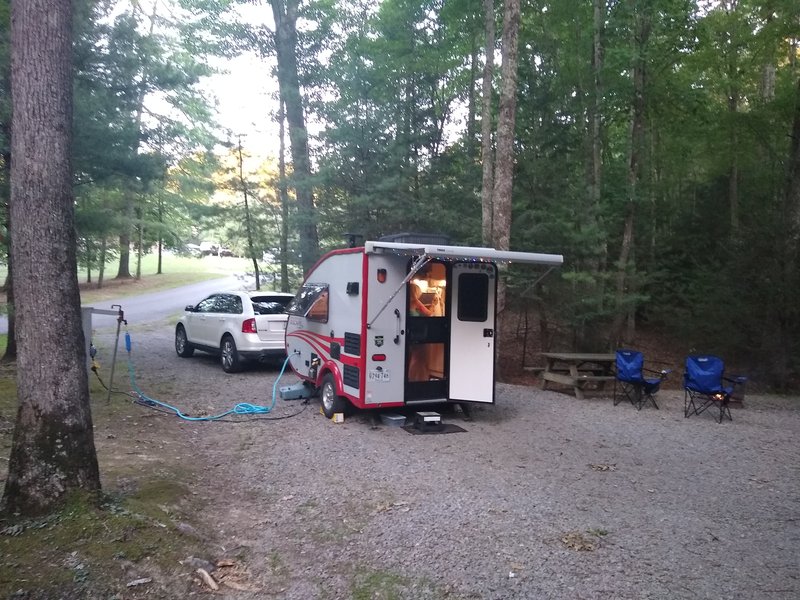
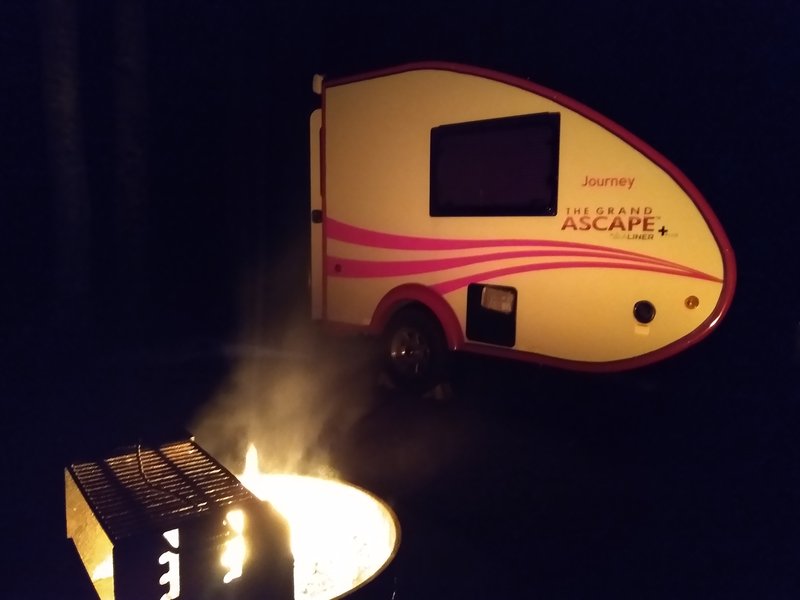
We were there mostly just as something to do. I 95% love our Aliner Ascape. The 5% is no indoor shower and the lack of separate dining and sleeping areas. We knew we wouldn't be finding anything at an RV show that fixes that 5%. From my research so far I've found exactly one option that might not require me to upgrade my tow vehicle, and that is a 16 ft Scamp. If I won the lottery I might upgrade to a smaller Airstream, and that is about as far as I go. Not having all the luxuries of home available is a feature of camping for me, not a bug. Bugs are also a feature of camping, but that is a different blog post.
Some thoughts on the RV show.
Class A RVs - do not want. It's not camping, it's traveling with your luxurious tiny home on wheels with you. I see the appeal for full timers or families of 7 that need that much space. But it's not for me.
Camper van / Class B - I kind of thought I might be a camper van person, but I found almost every one we were in claustrophobic. There just isn't much space to work with on a Dodge Ram or Sprinter chassis. Also, when you do the math the dollars per square foot of living space ratio on a van is really freaking high. I did see one or two with a slide or a pop up roof that felt more usable.
Class C RVs - saw a few that were interesting. At around $100K you are probably in the same price neighborhood that a newer truck and 5th wheel will cost. However you'd probably have to tow another vehicle to make getting around practical.
Travel trailers - I really feel like 20 feet is about as large as I ever want to go. My current trailer is 14 ft from the center of the ball to the edge of the bumper on the back. Also, I don't think I ever want a slide. I started adulthood as an engineering major in college, and when I see slides I see expensive, heavy components bound to fail at the worst possible time. Moving parts always fail, eventually. Heavy moving parts fail more frequently. Generally speaking, you won't see any smaller campers at RV shows. I assume it's because the profit on them doesn't justify the hassle of hauling them to a convention center.
There were two Tab Little Guy's at the show. I have always heard great things about them so I was surprised at how underwhelmed I was upon climbing into them. The smaller one wasn't a stand up teardrop unless you are under about 5'8". The larger one was fine, but it was basically an Ascape ST for $10K plus more. I know Tab pays attention to quality, but Aliner isn't $10K+ worse IMHO.
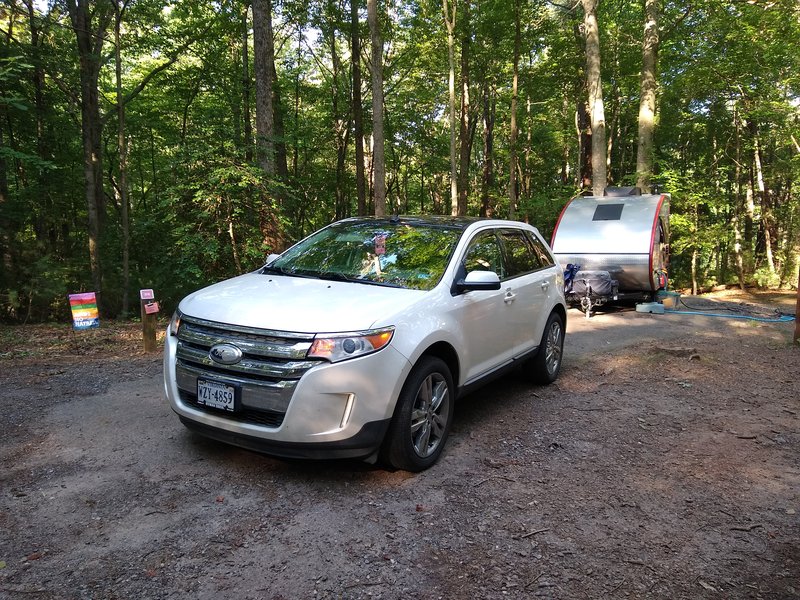
So what are we doing? Probably nothing. I would love to find some way to get a tour of a 16 foot Scamp with floor plan 6 or 7 this summer. I can't see myself ordering one without spending at least 5 minutes inside to get a feel for it. I guess if we get serious we could do a weekend trip to Minnesota to check one out at the factory. Maybe they'll be a Scamp rally in driving distance sometime this summer. I also need to confirm the weight of one as it looks like it's pretty close to safe line for towing with a Ford Edge. Or maybe we do nothing until I'm ready to upgrade the Edge. Either way, nothing happens until fall as we have a full summer of camping planned.
A summer that can't get here soon enough.
What Melba endured as a high school junior integrating Central High in 1957 can only be described as open warfare on African-Americans. The internal strength she and the rest of the Little Rock 9 exhibited, to get up and go to school every day, is something I can't even imagine.
I didn't enjoy reading about this shameful time in US history. In fact, I found it difficult to read. The abuse these 9 kids suffered to segregate Central High in Little Rock is really beyond explanation. I knew they had a tough time, but I didn't know it was the National Guard assigned to protect them enabled the abusers level of tough. I didn't know the 101st Airborne were assigned as literal bodyguards for the first couple of weeks of school. They should have been there all year, but I guess President Eisenhower couldn't risk upsetting the delicate sensibilities of white assholes in Little Rock.
The book is basically torture porn. But it's torture porn that should be required reading in every high school in America. Ironically, it's actually illegal in Virginia now, as our Trump-lite Governor has made it illegal to use any book in school that might hurt the feelings of a white person.
The irony of just how much white kids in Virginia need to read this book would clearly be lost on him.
The airlines have made it clear forever that once the door at the gate is closed, it’s closed. It doesn’t matter if you arrive at the gate 10 seconds after the gate agent closes the door, it’s too bad. You just missed your flight.
They are lying.
Yesterday, I was on Southwest Airlines Flight 1898 from Chicago Midway to Richmond. We boarded 90 minutes late because of the airline industry’s propensity to schedule pilots with the assumption that nothing ever goes wrong when flying. So our pilot was just taking off from Hartford, CT when he should have been doing pre-check stuff on our plane.
Our plane departed Midway at 4 PM. We were backing up away from the gate, and then the pilot announced we were returning to the gate to pick up two pilots that needed to deadhead to Richmond for a flight the next day. The pilot’s announcement sounded like these two pilots were literally at the door waiting for us, so no big deal.
After we had sat back at the gate for a few minutes, the pilot announced that the two hitchhiking pilots weren’t even at Midway airport. They were still en route to MDW on some other plane. In the end, we sat for about 45 additional minutes on a flight that was already 90 minutes late, after we freaking officially departed. I sensed our pilot was about as happy as his passengers.
So just remember the next time your flight is delayed, and you miss a connection by 1 minute that they are absolutely lying when they say they can’t open that door for you. Because they clearly can.
I just checked the Saturday MDW to RIC schedule. There are 55 non Southwest flights leaving after 4 PM, which was when we backed away from the gate. And that doesn’t even count the probably 100+ flights to Dulles or National that when combined with a 2-hour drive in a rental car could get the pilots to RIC from MDW. I don’t know if the airlines work together on this sort of stuff, but helping each other out with deadheading pilots if they have seats available should be something they do regularly. It really feels like somebody at Southwest decided we were already late, so our trip got sacrificed on the altar of corporate profits by making us sit there waiting for two pilots who were late because the airline makes pilots literally commute thousands of miles, versus having enough staff so that pilots aren’t changing planes with the rest of us.
Now that I’ve typed that, pilots not changing planes during the day, and not commuting via air, seems like it would be a win-win for pilots and passengers.
Also, if they wanted to do this, why not just keep us in the airport that extra 45 minutes? The flight was already late and another 45 minutes for an “operational” delay wouldn’t have seemed that unusual, and we’d all much happier in the airport than on the plane.
I choose to Fly Southwest because I expect better of them. Apparently, that faith was misplaced.
Last Thursday I had a non-stop flight from Richmond to Denver, which was a perfect opportunity to read Craig Calcaterra’s new book, Rethinking Fandom. It’s so new it’s not being released until April 5, but Craig and I are tight, so I got it early.
By “tight” I mean I have no idea why his publisher shipped the book a month early.
The timing was perfect, in that when I turned my phone back on after landing, literally minutes after finishing the book, I learned the players and owners had come to an agreement to end the lockout. I have not decided if I’m re-upping my MLB.tv subscription this year or not. I may just go with the cheap radio feed plan and watch whatever games are on Apple TV, ESPN, or the free game of the day on MLB.tv. This seems like a good year to test how much I’ll miss every Red Sox game (minus blacked out Orioles and Nationals games). The truth is, I rarely watch a full game anymore. I tend to watch a few innings several times a week, versus sitting down for an entire game. I prefer the radio commentary anyway, plus I really like going to sleep to the sounds of west coast games.
It’s not a large tomb, which is good. You can probably easily read the book in a couple of hours. It is divided into two sections. Section 1 reviews some of the more egregious examples of teams taking advantage of the fans and/or the local taxpayers. The Atlanta Braves white flight stadium deal gets attention, as does the “rooting for laundry” issue, labor issues, regular fans being priced out of attendance, and other things. One thing he brought up that I had not thought a lot about was the breakdown of the social contract between team and fans. The fact that the Florida Marlins and Pittsburgh Pirates can make a profit with no fans in the stands was not news to me. However, thinking about it in terms of the social contract was. The deal used to be the team tries to win, and we show up and buy $12 beers while cheering for the home team. However, in too many cases, the teams have broken that social contract because they think they don’t need the fans to make money. In the short term, they are probably right. In the longer term, they are killing baseball.
Section 2 of the book proposes that we fans have more power in this situation than we realize. Craig suggests that many of the old chestnuts of fandom no longer apply. It is absolutely okay to be a fair-weather fan. It’s okay to root for players inside the laundry, and not the laundry. Likewise, it’s okay to just be a casual fan and not obsess over every win or loss. Section 2 was fascinating to me, as I’ve been rethinking my fandom for a while now.
Closing the book on the Red Sox
I backslid on college basketball this year, but it reinforced what I wrote on that blog post. I’m happier as a casual fan, and I’m going back to being a casual fan. The emotional investment in the individual 2-hour games just isn’t fun for me anymore.
The rooting for laundry issue is relevant too, as I’ve wanted to be more of a Dodgers' fan in recent years because that is where Mookie Betts is. But it felt wrong to me. Craig says it’s not wrong, and I think he is right. Root for people, not laundry. Or root for the laundry. It’s your call. Likewise, it’s okay to ditch your team if ownership perpetrates racist stereotypes in the team name.
The big takeaway is that the sports we follow today are not the sports our fathers followed. It follows that our fandom can and should change too.
Any sports fan feeling the unease I’ve felt over recent years at how sports has changed will probably enjoy this book.